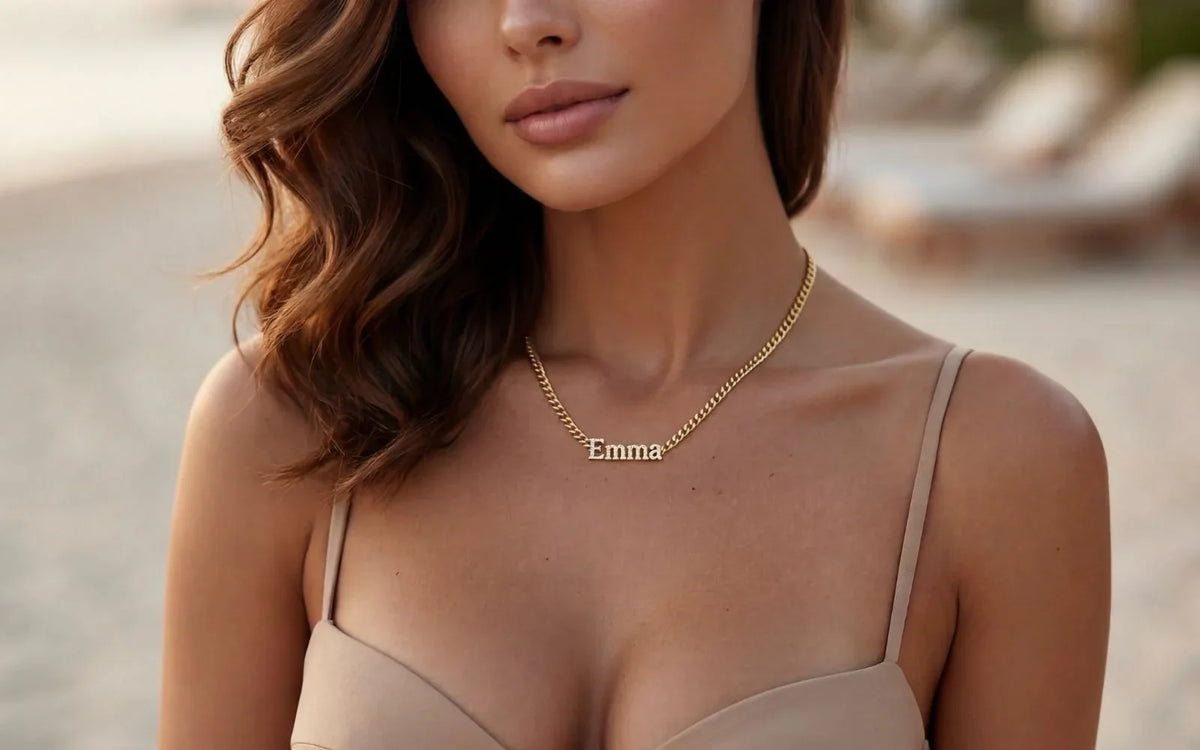
Article: Should You Choose a Name Necklace or an Initial Necklace?
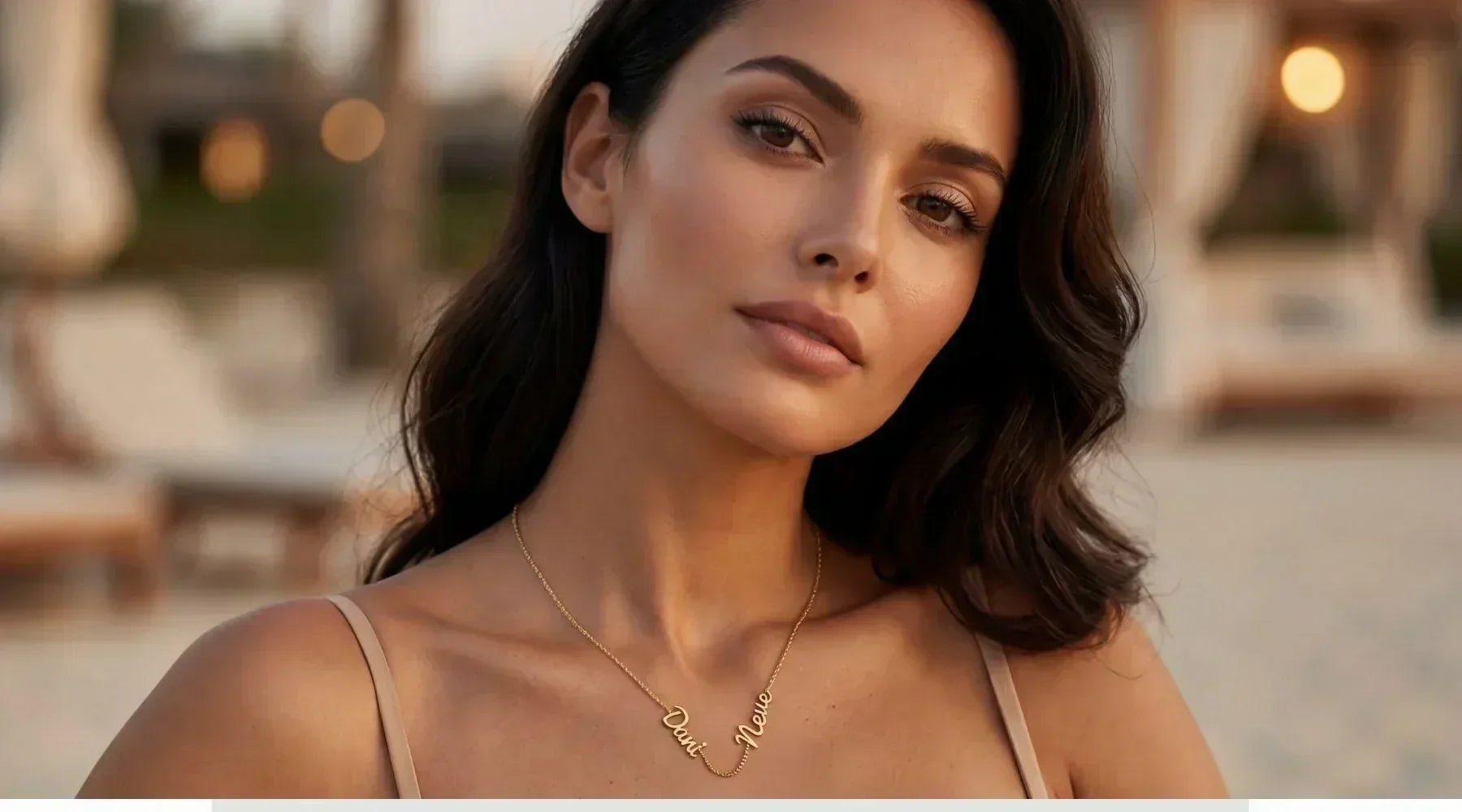
A name necklace tells your story out loud. An initial lets you carry it in code. Here's how to decide which one is actually right for you.
Should You Choose a Name Necklace or an Initial Necklace?
Full identity or coded identity — how to choose between the two, and why neither is automatically the more personal option.

Key Takeaways
- It's full identity vs coded identity A name necklace tells the story openly. An initial lets you carry it without explaining anything.
- Neither is more personal by default Emotional weight isn't measured in letter count — a single initial can carry as much as a full name.
- Initials protect your privacy A stranger can't tell if the letter is yours, a partner's, or a child's — useful for sharing online.
- 2026 favours scale Fewer, more substantial pieces are having a moment over endless delicate layering.
- Neither is automatically cheaper Letters, metal weight, gemstones and scale set the price — not the style you picked.
In This Guide
- Chapter I The Real Difference — what each style actually says
- Chapter II What We're Actually Seeing — celebrity examples and what they really show
- Chapter III Seven Ways to Decide — meaning, privacy, styling, gifting and cost
- The Verdict Final Decision: Name or Initial? — our honest recommendation
So: do you want your jewellery to explain the story, or hint at it? Meaning, privacy, styling, gifting, practicality, and 2026 appeal all point toward an answer. Neither design is automatically more personal — the right choice depends entirely on how explicitly you want to express your identity.
The Real Difference
What Is the Difference?
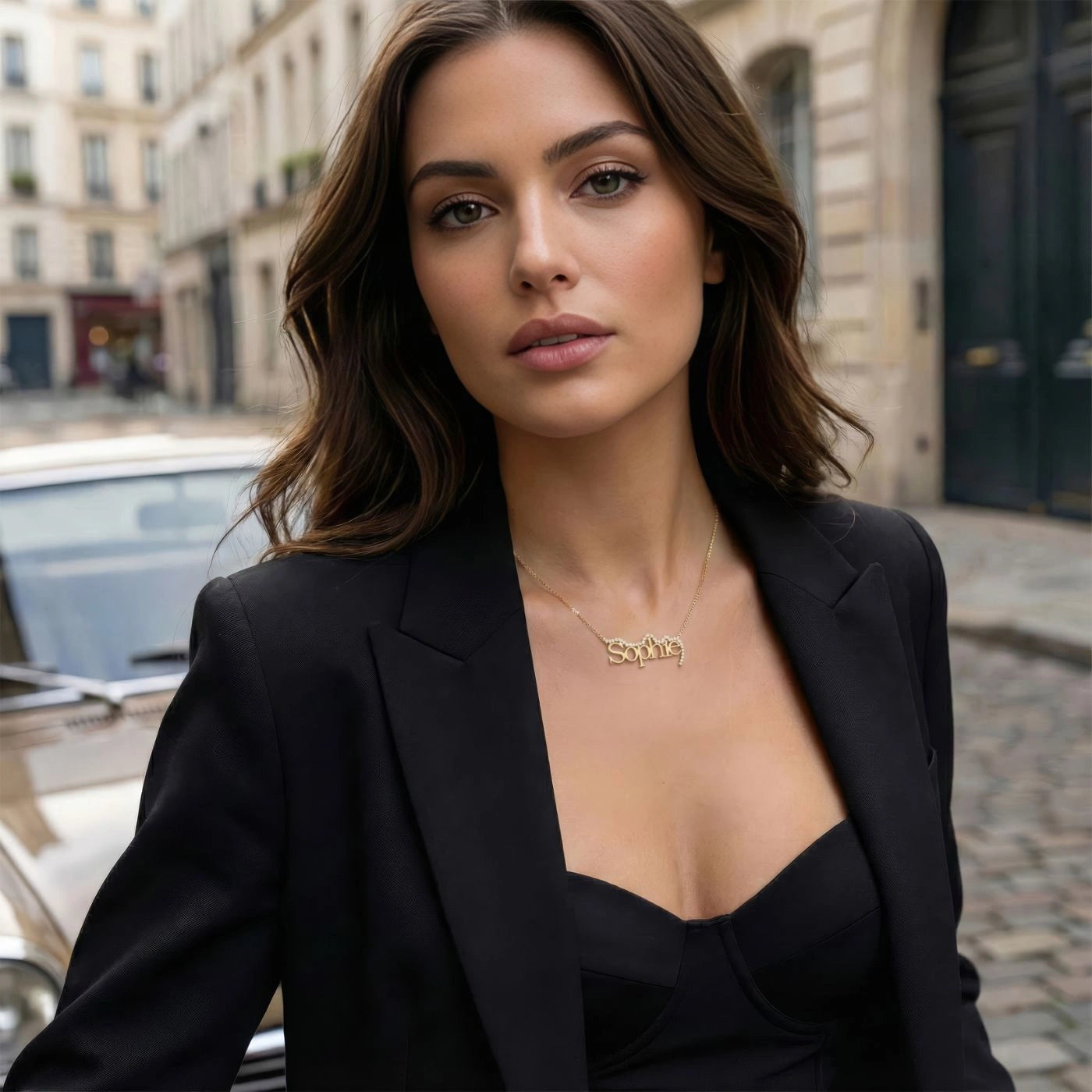
A name necklace features a complete word, with clear visual impact and literal identity. An initial necklace relies on one or more letters to create private symbolism.
| Feature | Name Necklace | Initial Necklace |
|---|---|---|
| Message | Full name, word or phrase | One or more letters |
| Meaning | Immediately readable | Often understood only by the wearer |
| Visual impact | More typographic and distinctive | More minimal or sculptural |
| Styling | Naturally becomes a focal piece | Easy to use as a base layer |
| Best for | Visible personalisation | Discreet sentiment |
Neither is inherently more personal. A full name can feel intimate because it's visible; one initial can carry an equally strong private meaning.

Why Initials Have Become Coded Jewellery
An initial can represent the wearer, a partner, a child, a surname, or a private memory. The reference might be obvious to the person wearing it and completely unclear to everyone else. An initial necklace is discreet by design; a name necklace communicates far more directly.
What We're Actually Seeing
The Stories People Read Into a Single Letter
Celebrity jewellery shows how quickly a single letter becomes a public conversation. A custom "T" necklace widely attributed to Taylor Swift resurfaced online in autumn 2025, having reportedly first appeared as a thigh chain earlier that year — fans read it as standing for either her own name or a partner's, proof that one letter can carry two meanings at once.
Meghan Markle offers a longer-running example. Her "H" and "M" necklace became closely associated with her relationship with Prince Harry, and she has also been photographed wearing an "A" initial, widely read as a tribute to her son, Archie.
Then there's Millie Bobby Brown's "Ruth" necklace — spotted in a 2026 Instagram image, sparking fan speculation about whether it revealed her daughter's name. Closer to home, Love Island's Charleen Murphy wore an Argent & Asher name necklace every day on the show, giving a whole new audience a look at how a personalised piece holds up under constant, real-life wear. Between all of these, the pattern is the same: a name necklace states your identity or your affection for someone; an initial lets you hint at it instead.

What These Examples Actually Demonstrate
Jewellery naturally becomes public storytelling, even without an official explanation. A single initial invites interpretation — onlookers guess at the story behind it — where a full name simply states it.
Media and online commentators often assign meanings the wearer has never confirmed. It's worth treating any reported meaning behind a celebrity piece with a healthy pinch of scepticism, rather than taking fan theory as fact. The real takeaway is simpler: personalised jewellery lets people carry their own story without ever having to explain it.
What Creators Are Actually Wearing
Scroll through either platform right now and you'll see name necklaces styled in every direction — elegant Arabic scripts, Morse code patterns, double-name plates, small charm accents like hearts or stars. Initial chains are just as popular: multiple letters layered for family, a birthstone added in, fonts ranging from tiny collarbone script to chunky bubble letters.
Gold remains the default for daily wear, with yellow, white and rose each giving off a distinct mood. Some creators wear a bold nameplate entirely alone; others layer delicate initials across a mix of chain lengths.
Seven Ways to Decide
Which Is More Personal?
There's no universal answer. Wearing your own name or initial expresses individual identity; displaying a partner's name, a child's initials, or a family surname honours someone you love. A meaningful word offers a daily personal touchstone. Never judge a piece by its letter count — a single initial can be just as precious as a full name.

Which Gives You More Privacy?
Full names make an immediate, clear statement. Initials preserve privacy, because a stranger can't tell whether the letter signifies your own name, a partner's, or a child's — useful for sharing online, or keeping a child's name out of public view. With name necklaces, remember you don't have to use a name at all: a special word keeps things stylish and private, and a charm can add meaning while staying open to interpretation.
Which Works Better as a 2026 Statement Piece?
Scale is everything here. A bold initial works like a heavy, sculptural pendant. A full name gives you typography-driven statement jewellery outright. The wider trend conversation backs this up: fewer, more substantial pieces are having a moment over endless delicate layering. Mixed metals and layered looks still have their place, but consider your lettering intentionally and let one hero piece take the lead.
Which Is Easier to Style?
A full name naturally becomes the focal point, especially in flowing script. A small initial sits at the collarbone as a base layer. Chain length and pendant width both matter, and the two can work together if each piece has enough visual breathing room.
Which Is Better for a Long or Unusual Name?
Initials are often easier when a name is long, double-barrelled, or hard to balance across a pendant. Very short names can work beautifully as full-name designs, and nicknames or meaningful words offer another route. For unusual spellings or scripts, ask for a design proof before production.
Which Makes the Better Gift?
It depends on your recipient's taste and your intended message. A full name is a strong, public statement for a partner, daughter, teenager, or memorial tribute. Initials are the lower-risk choice for a mother, new parent, or friend — more private, and safer if you're unsure whether they'd actually wear their own name, or want to avoid a spelling mistake entirely.
Which Usually Costs More?
Neither is automatically cheaper — no fixed price rule applies. A name necklace rises in price with added letters, heavier gold, custom typography or thicker metal. Diamonds, gemstones, scale and chain selection raise costs on either style. An ornate diamond initial can easily cost more than a minimal gold-plated nameplate, so judge the material specification, not the letter count.

Final Decision: Name or Initial?
If you want a strong signature piece, a name necklace is the better option — a full name carries the meaning outright. If you have a long name, or you simply prefer subtle details that spark conversation while keeping the meaning discreet, an initial necklace is the one for you.
Honestly, we'd say go for both if you can — switch between them as the occasion demands, or layer them together.
Explore Argent & Asher's personalised necklace collection for both initials and names, made to order from solid 9ct, 14ct or 18ct gold. Whichever you choose, our artisans in London can design your bespoke signature piece today.
Everything Else Worth Knowing
Is an initial necklace more fashionable than a name necklace?
No — both are equally relevant in 2026.
Should you wear your own initial or someone else's?
Either — choose the person or memory you want to carry.
Is a name necklace a good gift?
Yes, especially when the name or word has clear meaning — just double-check the recipient's spelling and taste first.
Which is better for a teenager?
An initial is the safer choice if you're unsure of their style, or if they prefer to keep things low-key.
Can you wear an initial and a name necklace together?
Yes, and it's genuinely fashionable — just make sure the scale and chain lengths complement each other.
Are full-name necklaces too personal?
Not necessarily — they're simply more openly personal. Opt for a word instead of a name if that feels like too much.
What's the most popular initial-necklace style?
Small, clean letter pendants remain the most versatile choice.
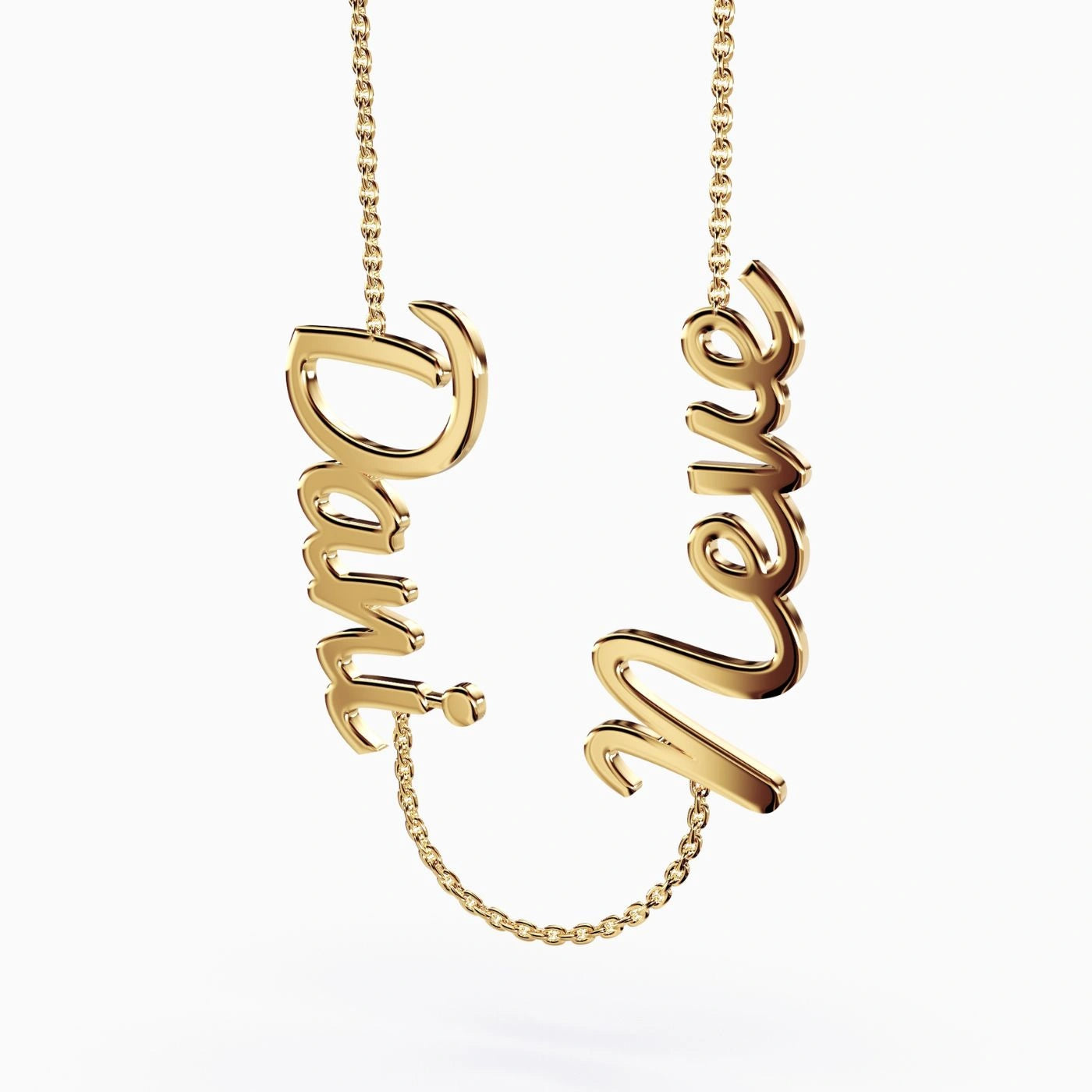

Double Name Necklace
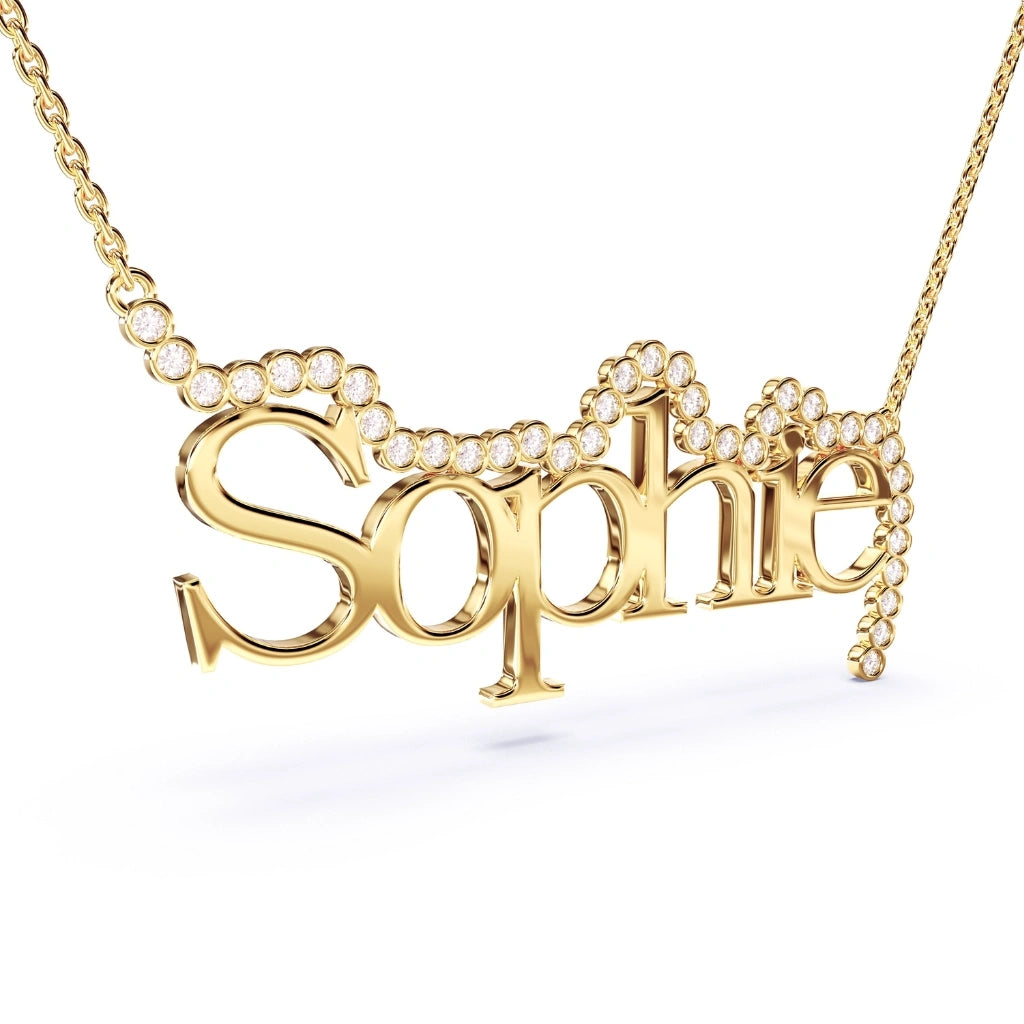
Custom Crest Name Necklace

Written by Katie Silver