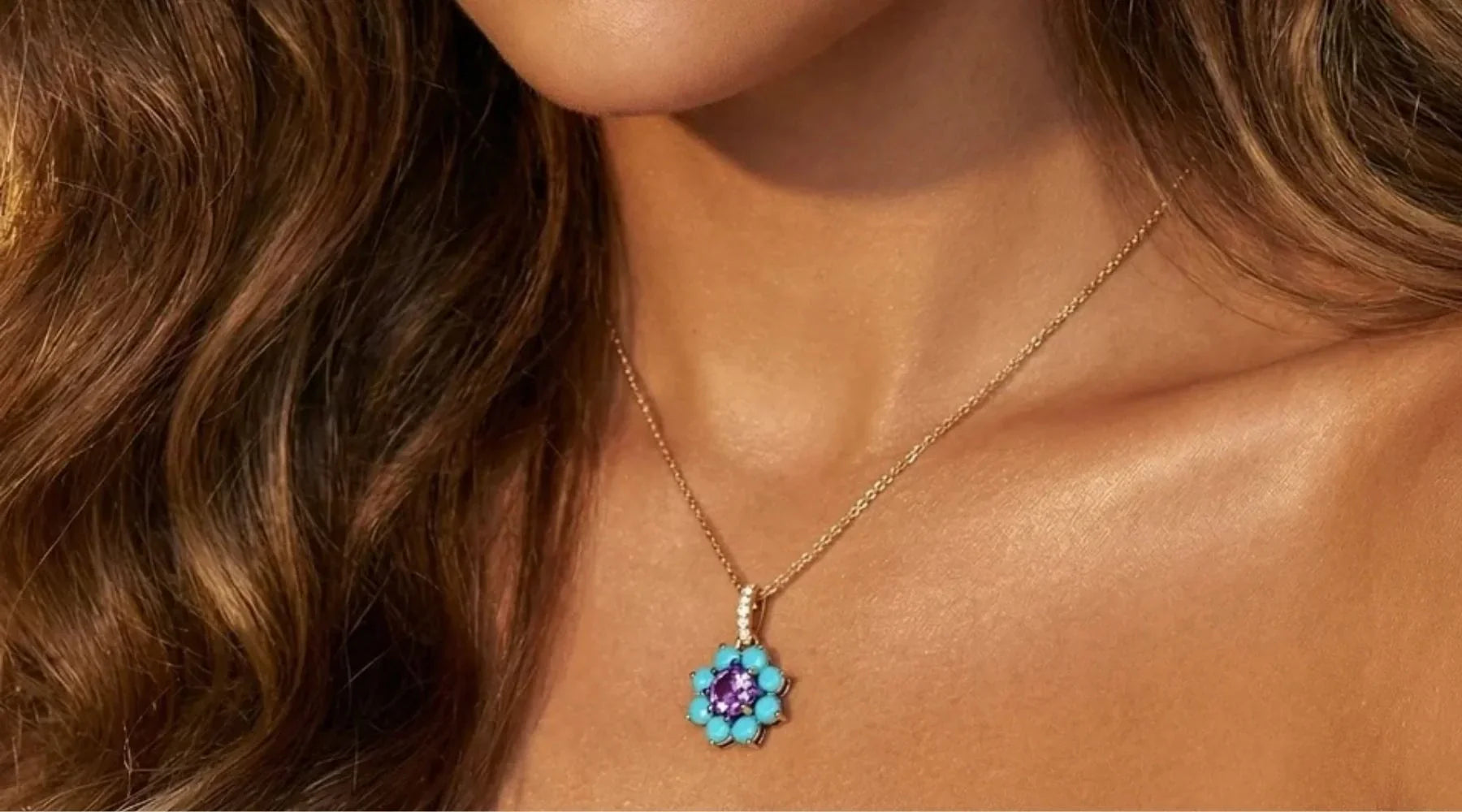
Turquoise Jewellery — Everything Worth Knowing
The blue-green stone that has outlasted every trend cycle — what it actually is, why it carries genuine cultural weight, and how to wear it without it wearing you.

Key Takeaways
- Not all turquoise is the same stone Natural, stabilised, and dyed are three very different things — and the price difference between them is significant. Know what you're buying.
- It works on every skin tone The blue-to-green range means there's a shade that flatters warm, cool, and neutral undertones. The trick is finding the right cast for yours.
- It has genuine cultural history In Native American, Persian, Tibetan, and Egyptian traditions, turquoise isn't decorative — it's protective. That history is part of what you're wearing.
- It's one of the more ethically sourceable gemstones Lower environmental impact than many mined stones, with a long tradition of artisan-scale production and traceable supply chains.
- Yellow gold is the stronger pairing It picks up the copper undertones in the stone and makes the combination feel intentional rather than accidental. Silver works — but differently.
- One piece is a statement. Three is a costume. Turquoise has presence. It doesn't need help. The most common mistake is wearing too much of it at once.
In This Guide
- Chapter I What Turquoise Actually Is — the mineral, the deposits, and why not all of it is equal
- Chapter II The Weight It Carries — 5,000 years of cultural and symbolic history
- Chapter III The Sustainability Argument — why it matters, and what to look for
- Chapter IV How to Wear It — practical guidance on metal pairings, stacking, and getting it right
It's a stone with genuine history behind it — not the vague "timeless" sort that gets applied to anything over 50 years old, but specific, documented, cross-cultural history. The Egyptians were mining it in the Sinai 5,000 years ago. Native American silversmiths were working with it long before European contact. The Persians covered palace walls in it. If a stone has appeared in Tutankhamun's burial mask and on Bella Hadid's wrist, it probably merits more than a trend piece.
Here's what you actually need to know — about the stone itself, what it means, how to buy it responsibly, and how to wear it without it getting the better of you.
Also read: Jewellery trends worth paying attention to
What Turquoise Actually Is
Copper, aluminium, and a very specific shade of blue
Turquoise is a phosphate mineral, formed when copper-rich water moves slowly through aluminium-bearing rock. The copper is what produces the blue; the presence of iron shifts it towards green. The two together create the shade — somewhere between a clear sky and a shallow sea — that makes it unmistakable. The exact cast varies by deposit: Persian turquoise tends to a vivid, saturated medium blue; the stones from the American Southwest range from sky blue to mottled blue-green; Tibetan turquoise often reads greener, with more pronounced matrix.
It's one of the most widely distributed gemstones on the planet. The most sought-after deposits are in Iran, the American Southwest (Arizona and Nevada), and Tibet. Egypt's Sinai Peninsula was the earliest known mining site — the ancient Egyptians were extracting it more than 5,000 years ago. Some of those mines are now largely exhausted; the Sleeping Beauty mine in Arizona, once the benchmark for clean sky-blue stones, closed in 2012 and what remains commands a premium.
Natural, stabilised, or dyed — know what you're buying
Most turquoise sold in contemporary jewellery has been stabilised — impregnated with resin under pressure to harden it and deepen its colour. This isn't dishonest. Natural turquoise is soft (around 5–6 on the Mohs scale), porous, and prone to absorbing oils and moisture from the skin. Stabilisation makes it significantly more durable and wearable. A stabilised stone from a good mine, set well, is excellent jewellery.
What matters is transparency. Natural untreated turquoise is rare and expensive. If you're being offered it at a low price, it's almost certainly stabilised or dyed — and a reputable jeweller will tell you which. Dyed howlite (a white stone that takes colour well) and glass simulants are also widely sold as turquoise, particularly in fashion jewellery; neither is a gemstone. The difference in price and longevity between a natural stone and a simulant is substantial.

The Weight It Carries
5,000 years of protection, wisdom, and meaning
There are very few gemstones that appear, independently, in the cultural histories of four entirely separate civilisations — each attributing it with broadly similar meaning. Turquoise is protective. It is associated with heaven, with good fortune, and with the safe passage between worlds. That's not a marketing line; it's the consistent interpretation across Native American, Persian, Tibetan, and Egyptian traditions.
In Navajo, Zuni, and Hopi silverwork, turquoise is the stone of life — worn for protection and carried in ceremony. Persian kings embedded it in weaponry and palace walls; the word turquoise itself comes from the French for "Turkish stone," a reference to the trade routes that brought Persian turquoise to Europe. In Tibet it's known as a life stone, worn from birth. Tutankhamun was buried with it in 1323 BCE. Whatever your view on the spiritual properties of stones, the consistency of those associations across thousands of miles and thousands of years is at minimum interesting — and arguably worth knowing before you treat it as a seasonal accessory.
Also read: Jewellery trends worth paying attention to
The stone people reach for when they want to feel grounded
Beyond the formal cultural associations, turquoise has a more contemporary one: it's the stone people tend to reach for during periods when they want to feel steadier. This isn't a claim about metaphysical properties — it's an observation about behaviour. It appears consistently in spaces associated with meditation, yoga practice, and intentional living. Crystal therapists associate it with communication and calm. Whether you hold to any of that is your business.
What's easier to defend is that wearing something with meaning behind it changes the experience of wearing it. Jewellery that feels like it has a point — even a personal, private point — is different from jewellery that's purely decorative. Turquoise has a history of carrying that kind of weight. What you make of it is up to you.
The Sustainability Argument
A lower-impact stone — when sourced responsibly
Part of the recent resurgence in turquoise — particularly among buyers who think carefully about where their jewellery comes from — is the sustainability case. Turquoise doesn't require the energy-intensive processing of diamonds. It's a naturally occurring stone that has been mined at artisan scale for millennia, which means supply chains are often more traceable than those for mass-market coloured stones. Many of the best producers are small operations with direct relationships between miners and makers.
The caveat is "when sourced responsibly." Like any mined stone, turquoise can be extracted irresponsibly, and the market for cheap dyed simulants undermines the livelihoods of traditional miners. Buying from jewellers who are transparent about provenance — who can tell you the mine, the treatment, and the supply chain — is the only way to make the sustainability argument hold.
Turquoise Types & Quality Guide
What you're looking at when a jeweller describes the stone — and what it means for price, durability, and longevity.
| Type | What It Means | What to Expect |
|---|---|---|
| Natural | Untreated, straight from the mine | Rarest and most valuable. Colour variation is natural; patina develops over time. Handle with care. |
| Stabilised | Resin-treated under pressure to harden the stone and deepen colour | Most common in fine jewellery. Excellent durability, consistent colour. The standard for everyday wear. |
| Enhanced / Dyed | Surface-treated or colour-dyed to improve appearance | Lower price point. Fine when disclosed honestly. Colour may fade with wear and water exposure. |
| Simulant | Dyed howlite, glass, or resin made to look like turquoise | Not a gemstone. Fine for fashion jewellery, but should be sold as such — not as turquoise. |
How to Wear It
Gold or silver — they give you two completely different results
Yellow gold picks up the copper undertones in turquoise and makes the combination feel considered — warmer, richer, more jewel-like. It's the pairing that tends to look most flattering on warmer skin tones, and it gives the stone a slightly dressed-up quality even in a casual context. If you're buying a single turquoise piece and you're not sure which metal to choose, gold is the stronger call.
Sterling silver — the traditional pairing in Native American jewellery — is cooler, more graphic, and less forgiving. It works better against cooler complexions. White gold sits between the two in temperature, with slightly more lustre than sterling. Oxidised silver, where the metal is deliberately darkened, gives a more bohemian feel and is excellent with heavily matrixied stones. The point is that the same stone reads entirely differently depending on what it's set in — so it's worth being intentional rather than defaulting to whatever the piece happens to be made in.
The mistake everyone makes, and how to avoid it
Turquoise is a statement stone. It has colour, cultural history, and visual presence — and all of that means it doesn't stack well with other coloured stones unless you know what you're doing. The most common mistake is mixing turquoise with coral, lapis, malachite, or amber in the same outfit. Individually, each is strong. Together, they compete. The overall impression is less curated collection, more souvenir market.
The rule for stacking turquoise: let it anchor one length, and layer plain metals above or below. A turquoise pendant at the collarbone looks better with a plain gold chain at the throat and nothing else than it does surrounded by other stones fighting for the same attention. As a ring, it's strongest alone or with plain bands; in a bracelet stack, keep it with plain gold bangles rather than other gemstone pieces. The stone earns its place by standing out — don't dilute that.
Also read: Explore our turquoise jewellery collection
Everything Else Worth Knowing
Is turquoise a precious or semi-precious stone?
Turquoise is classified as semi-precious — the traditional precious stones are diamonds, rubies, emeralds, and sapphires. That said, the distinction is largely a historical convention rather than a strict quality marker. High-quality natural turquoise from premium deposits in Iran or the American Southwest commands serious prices, well above many stones in either category. The label matters less than the quality and provenance of the specific stone.
Does turquoise change colour over time?
Natural untreated turquoise can. It's porous, which means it absorbs oils from the skin, cosmetics, and cleaning products — and that absorption gradually shifts the colour from blue towards green. Many people consider this patina part of the stone's character. Stabilised turquoise (the most common type in contemporary jewellery) is much more resistant to colour change, as the resin treatment seals the porous surface.
How do I know if my turquoise is real?
The surest route is a certificate from a reputable gemmological laboratory, or a straight answer from your jeweller. Visual clues: natural and stabilised turquoise shows matrix — the dark veining from the host rock — that looks organic and irregular. Perfectly uniform colour without any variation is often dyed howlite or glass. A good jeweller should be transparent about treatment; if they're not forthcoming, that tells you something.
Can I wear turquoise in water?
Better not to. Turquoise is porous, and prolonged exposure to chlorinated or salt water can cause discolouration and weaken the stone over time. Stabilised turquoise handles moisture better than natural stone, but the safer habit is to remove turquoise jewellery before swimming, bathing, or applying skincare.
What does turquoise symbolise?
Across cultures, turquoise has been associated with protection, wisdom, and good fortune for thousands of years. In Native American traditions it is a life stone; in Persian culture, a symbol of heaven; in Tibetan practice, a protector worn close to the body. The Egyptians buried their dead with it — Tutankhamun's mask being the most famous example. Whether or not you hold to any of those beliefs, the stone arrives in your jewellery box already carrying a story.
Is stabilised turquoise less valuable than natural?
Generally, yes — natural untreated turquoise commands a premium, particularly from sought-after mines. But stabilised turquoise is a legitimate gemstone, not a fake, and the resin treatment significantly improves durability. Most turquoise in contemporary jewellery is stabilised. The important thing is transparency: a good jeweller will tell you exactly what you're buying.
Does turquoise work better with gold or silver?
Both work, but they give very different results. Yellow gold picks up the warm copper undertones in the stone and reads richer, more jewel-like. Sterling silver — the traditional pairing in Native American jewellery — is cooler and more graphic in character. Yellow gold tends to flatter warmer skin tones; silver suits cooler complexions. White gold sits somewhere between the two. If you're unsure, go gold.
Worth it — when you know what you're choosing
Turquoise is having a moment because it was always good — and because the things people currently care about (cultural depth, ethical sourcing, longevity over trend) are things turquoise has always had. The difference now is that we're paying attention to them.
Buy it knowing what it is and where it comes from. Set it in yellow gold if you want it to feel rich, silver if you want it to feel graphic. Wear it as the one statement piece in an otherwise plain outfit. Let it do its thing without competition. That's all it needs.
Also read: Browse the turquoise collection at Argent & Asher
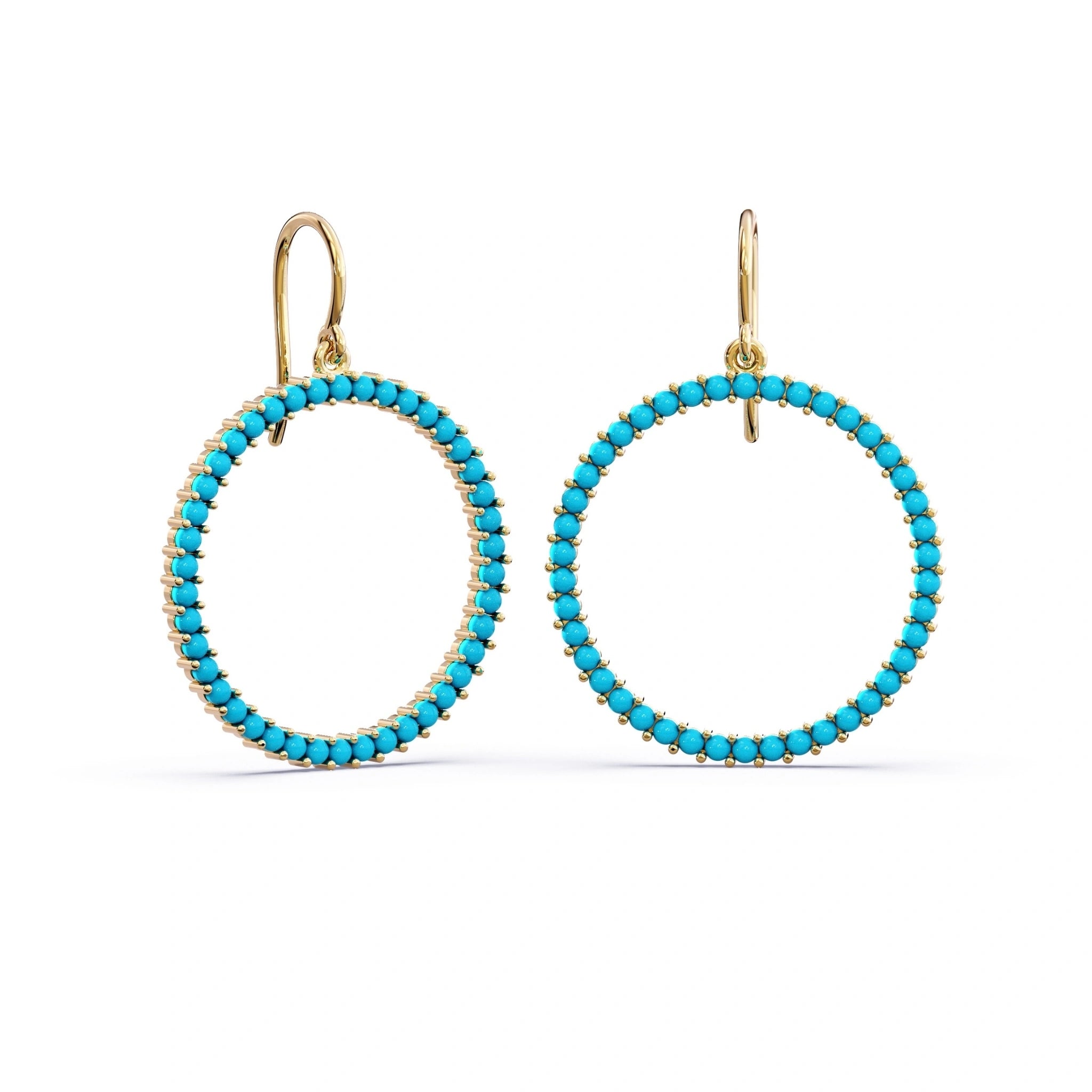
Oversized Turquoise Hoops


Bezel Set Turquoise Tennis Necklace

Written by Katie Silver