A guide to choosing between lab-grown and natural diamond name necklaces, exploring rarity, value, ethics, craftsmanship and long-term wear so you can confidently choose the piece that feels right for you.
How to Choose Between Lab-Grown and Natural Diamond Name Necklaces
A proper guide to weighing rarity, ethics, budget, and sentiment — so you can choose the diamond name necklace you will actually love wearing forever.
Key Takeaways
- Neither choice is a wrong one Natural and lab-grown diamonds both produce genuinely beautiful name necklaces — what differs is their origin, price, and what they mean to you.
- They are physically identical Lab-grown diamonds share the exact same chemical composition and hardness as mined stones — they are not imitations, they are diamonds.
- Budget shapes the decision significantly Lab-grown stones cost considerably less, meaning the same outlay stretches to a larger stone or a more intricate design.
- Natural diamonds hold their value better Rarity underpins resale value — natural stones depreciate more slowly, making them the stronger choice if long-term investment matters.
- Both last a lifetime Diamonds score a 10 on the Mohs hardness scale regardless of origin — durability is never the reason to choose one over the other.
- Always insist on certification Whether natural or lab-grown, only buy with an IGI or GIA certificate — it is the only independent guarantee of what you are actually getting.
In This Guide
- Chapter I Understanding Natural Diamonds — the origins, the appeal, and the honest trade-offs.
- Chapter II Understanding Lab-Grown Diamonds — how they are made, why they have grown so popular, and where they fall short.
- Chapter III Key Factors to Consider — budget, aesthetics, ethics, longevity, occasion, and personal values, side by side.
- Chapter IV Six Tips for Buying with Confidence — practical guidance to ensure you get the piece you actually want.
Once you decide you want one, a question arrives almost immediately: natural diamond or lab-grown? It is a decision that touches on more than budget — it involves rarity, ethics, sentiment, and what a diamond is supposed to represent. Some buyers want billions of years of geological history close to the skin. Others appreciate that a lab-grown stone offers the same sparkle and durability without the same financial outlay.
The good news is that neither answer is wrong. This guide sets out both options properly, so you can make the decision that actually fits what you value.
Also read: Diamond name necklaces — the full collection at Argent & Asher

Understanding Natural Diamonds
The Case for Mined Stones
Natural diamonds form over billions of years deep inside the earth, under immense pressure and heat, long before anyone digs them up and cuts them for jewellery. That process — ancient, irreproducible — is precisely what gives them their mystique. Every single stone carries unique inclusions and internal characteristics. You are never getting a copy of someone else's diamond.
This rarity connects them, culturally and sentimentally, to luxury and tradition. Natural diamonds remain the default for engagements and heirlooms — pieces meant to carry emotional weight across generations. There is something undeniably compelling about wearing a piece of genuine ancient history, and for many buyers that is precisely the point.
From a value standpoint, natural diamonds also hold their price far better over time. Scarcity underpins that resilience. While jewellery should never be purchased purely as a financial instrument, it is worth knowing that a natural diamond name necklace is unlikely to depreciate as sharply as its lab-grown equivalent.

The Points Worth Weighing
Natural diamonds come at a cost premium. On a fixed budget, you will get a smaller stone or a simpler setting than you would with a lab-grown equivalent — that is simply the arithmetic of rarity. If carat weight and visual impact are your primary concern, natural stones make the trade-off more demanding.
The environmental and ethical dimension is also worth acknowledging honestly. Diamond mining carries a significant planetary footprint. Ethical sourcing standards have improved considerably over the past decade, and responsibly mined stones are increasingly traceable — but it remains a sticking point for buyers who prioritise sustainability as a primary value.
The rarity that makes natural diamonds appealing also limits availability — sourcing a very specific colour or clarity grade can take longer and push costs up. For a diamond letter name necklace intended as a generational heirloom, these trade-offs are usually well worth accepting.
Understanding Lab-Grown Diamonds
The Case for Cultured Stones
Lab-grown diamonds are produced in controlled environments that replicate the conditions found deep inside the earth — extreme heat and pressure applied to a carbon seed until a crystal forms. They are not simulants like cubic zirconia. They are chemically and physically identical to mined diamonds: the same hardness, the same refractive index, the same sparkle. A gemologist without specialist equipment cannot tell the difference.
The price difference is the most obvious advantage. The same budget that buys a modest natural stone can fund a significantly larger or more intricate lab-grown name necklace — a meaningful consideration when you are commissioning a piece with multiple stones set along a full name. For bespoke designs and unusual shapes or sizes, lab-grown stones are also far easier to source quickly.
The sustainability argument is genuinely compelling for many buyers. Skipping the mining process removes the most significant environmental and ethical concerns attached to natural diamonds. Lab diamonds are grown without displacing communities or landscapes — and for a growing number of people making considered luxury purchases, that matters deeply.

The Points Worth Knowing
Lab-grown diamonds do not hold their value the way mined stones do. Because they can be manufactured at increasing scale, their market price has been falling — and is likely to continue. If you intend to sell the piece in future, or to pass it on with financial as well as sentimental worth, that gap matters.
There is also the question of tradition and perception. For buyers and recipients steeped in the cultural heritage of natural diamonds — for whom the geological age and rarity of the stone is part of what makes the gift meaningful — a lab-grown alternative may feel less weighty, regardless of how it looks on the necklace. That is not a rational distinction, but sentiment rarely is.
It is also worth noting that while labs sidestep mining, they are energy-intensive operations. The sustainability case for lab-grown stones is strong relative to mining, but it is not an entirely clean picture. Neither path is perfectly green — the question is which trade-offs you are most comfortable with.

Key Factors to Consider
Budget & Appearance
If budget is your main constraint, lab-grown diamonds give you substantially more for your money. A larger stone, a more elaborate setting, a longer name covered in more diamonds — the same outlay goes considerably further. Natural stones, by contrast, make most sense when rarity and long-term value outweigh the desire for sheer size or complexity of design.
On appearance, they are genuinely identical to the naked eye. Natural stones have those minute internal inclusions that make each one singular — a characteristic many collectors find quietly beautiful. Lab-grown stones, grown in controlled conditions, tend toward greater visual uniformity and clarity. Neither is objectively better-looking; it is a matter of whether you value natural individuality or cultivated perfection.
Ethics, Longevity & Occasion
On sustainability, lab-grown stones carry a clear advantage — they bypass the mining process entirely. Modern regulations have raised standards for responsible natural diamond sourcing considerably, and ethically mined stones are increasingly traceable. But labs remain the simpler choice if environmental impact is a deciding factor for you.
Durability is a non-issue for either type. Both score a 10 on the Mohs hardness scale — the highest rating possible. With reasonable care, a diamond name necklace will outlast its owner regardless of whether the stones came from the ground or a laboratory. Where they diverge is in resale value, and that gap is widening as lab-grown production scales up globally.
On occasion: a dainty diamond name necklace worn daily — to work, layered with other pieces — is an ideal candidate for lab-grown. The economics make more sense for everyday wear. But if the piece marks a significant milestone — a birth, a coming-of-age, something intended to be passed down — the added gravitas of a natural diamond often justifies the extra investment.
Personal Values
Ultimately, the emotional dimension is entirely personal. A natural diamond carries old-world romance — it is a gift of geology, of deep time, of something that could not be manufactured on demand. That carries weight for many buyers that no amount of physical equivalence can replace.
A lab-grown diamond, meanwhile, sits comfortably with modern values around ethics and accessibility. For a buyer who wants a diamond name necklace that reflects a contemporary outlook — and who is unbothered by tradition for its own sake — the cultured stone makes complete sense.
The decision is not about what is trending. It is about personal connection: to history, to ethics, to the person you are buying for. Neither stone is more real than the other. They are simply different in origin — and in what that origin represents to you.
Natural vs Lab-Grown at a Glance
Both types of diamond make a genuinely beautiful name necklace. This table shows where they differ, side by side.
| Factor | Natural Diamond | Lab-Grown Diamond |
|---|---|---|
| Cost | Higher | Lower |
| Appearance | Unique inclusions, one-of-a-kind character | Very clean and visually uniform |
| Rarity | Rare, finite resource | Readily available |
| Ethical Impact | Mining concerns; responsibly sourced options available | Mining-free; energy-intensive production |
| Resale Value | Higher potential; holds price better over time | Depreciating as availability increases |
| Longevity | Lasts a lifetime | Lasts a lifetime |
| Emotional Appeal | Historic, rare, deeply traditional | Contemporary, practical, ethically minded |
| Availability | Specific grades can be harder to source | Wide range of shapes and sizes readily available |
Six Tips for Buying with Confidence
Certification & Choosing Your Jeweller
Always insist on a certificate from IGI or GIA. A diamond name necklace is not an inexpensive purchase. Certification is the only independent guarantee that the stone you are paying for is exactly what the jeweller says it is — correct cut, colour, clarity, and carat weight. Any jeweller worth working with offers this as standard.
Choose a jeweller who is transparent about their craftsmanship — materials, setting techniques, stone sourcing, and quality control. If a shop obscures these details or cannot answer straightforward questions about how the piece is made, proceed with caution. Look for clear return policies and an obvious commitment to customer service. A jeweller who is proud of their work will show you exactly how it is done.
Metal, Customisation & Policies
Avoid plated metal for a diamond name necklace. Plating wears through over time and can leave the setting unable to hold the stones securely. Invest in solid 14k or 18k gold — it will last the lifetime of the piece, and the diamonds it holds will thank you for it.
If the necklace is a gift, think carefully about customisation. A good independent jeweller will offer a range of fonts and scripts — bold block letters, delicate cursive, English, Arabic. A custom diamond name necklace made with real thought behind it means considerably more than anything mass-produced.
Check adjustment and return policies before committing. Chain length is easy to get wrong, and knowing whether a jeweller will fix it — and on what terms — protects your investment from the outset. Read the terms, not just the marketing copy.
Inspecting Images & Videos Carefully
When buying online, photographs can mislead. Heavy filtering, dramatic studio lighting, and extreme close-ups can make a thin, lightly set piece look far more substantial than it actually is. Look for raw video footage of the necklace being worn — it gives you a far more accurate sense of letter thickness, stone coverage, and how the piece moves and catches light in real conditions.
A jeweller who is confident in their craft will show you their work exactly as it is. If the product imagery looks over-produced or the jeweller is reluctant to provide honest context, proceed with caution. The sparkle of a well-made diamond name necklace needs no enhancement — it speaks entirely for itself.
Everything Else Worth Knowing
Can you tell a lab-grown diamond from a natural diamond?
Not easily — and certainly not with the naked eye. Specialised equipment is required to identify the difference accurately. To anyone looking at your necklace, the stones are simply diamonds.
Are lab-grown diamonds real diamonds?
Yes. Lab-grown diamonds share the identical chemical composition, crystal structure, and physical properties as mined diamonds. They are graded by the same standards, certificated by the same independent bodies, and set using the same techniques.
Do lab-grown diamonds lose value faster?
Yes. Because they can be produced at increasing scale, the market price for lab-grown stones has been falling and is likely to continue to do so. If financial value over time matters to you, natural diamonds are the more resilient choice.
Are natural diamonds always better for heirlooms?
Natural diamonds have an undeniable traditional appeal for heirlooms — scarcity, age, and rarity all contribute to their gravitas. That said, a lab-grown diamond name necklace made with care will carry deep sentimental value for future generations regardless of where the stones originated.
Which is better for ethical and sustainable jewellery?
Lab-grown diamonds are generally considered the more sustainable option because they eliminate mining entirely. If you prefer natural, look specifically for responsibly sourced stones with clear provenance — traceable supply chains now exist across much of the industry.
Also Read: Name Necklace Trends for 2026
The Stone That Is Right for You
Forget what is trending. The best diamond for your name necklace is the one that aligns with your budget, your ethics, and your sense of what the piece is meant to represent. A diamond name necklace will always feel deeply intimate — whether the stones came from billions of years underground or from a controlled laboratory, they catch the light in exactly the same way.
A diamond letter name necklace, made with either stone, will last a lifetime. The decision is yours — and it is a better one for having thought about it properly.
Take a look at the diamond name necklaces collection at Argent & Asher — you are bound to find something you love.
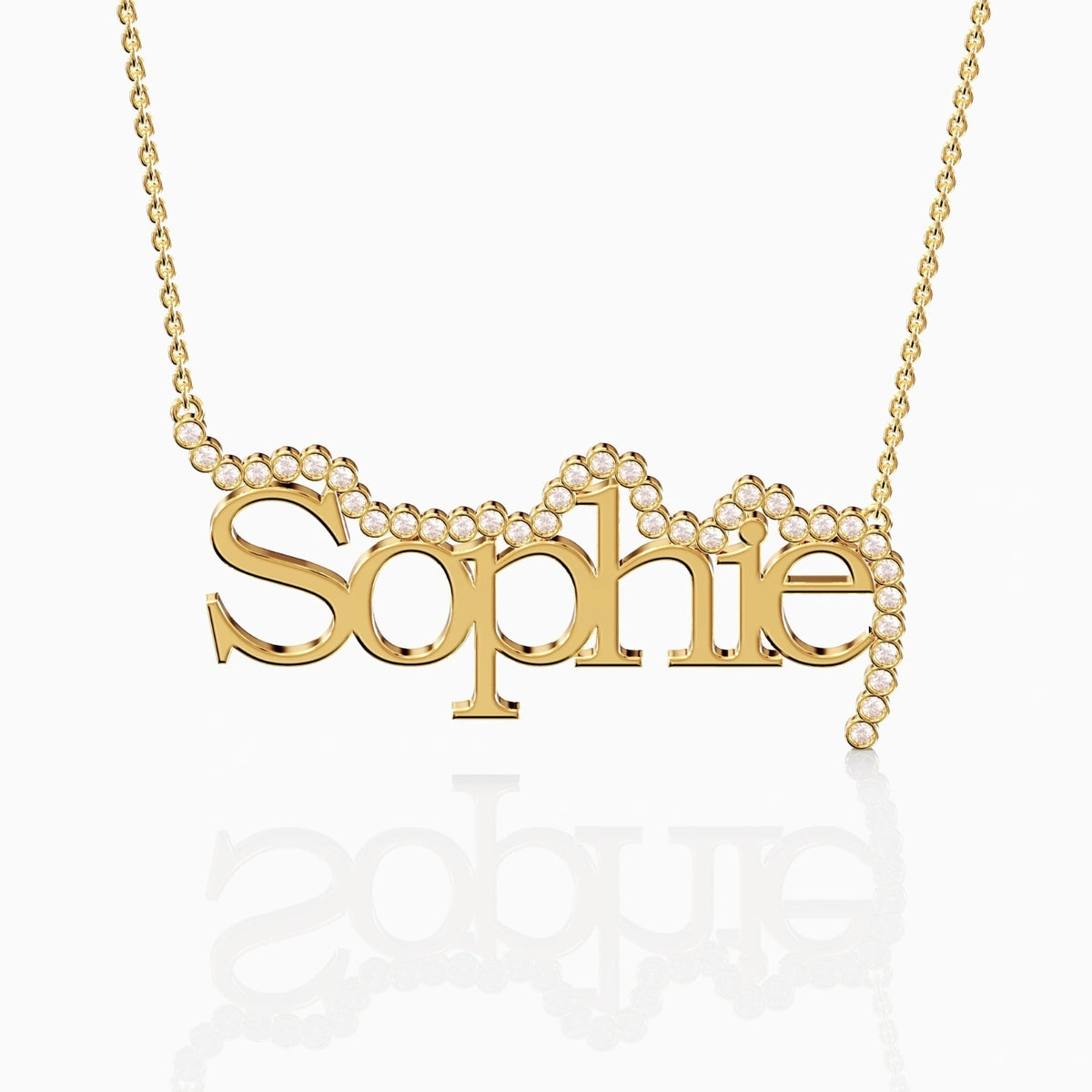

Custom Crest Name Necklace
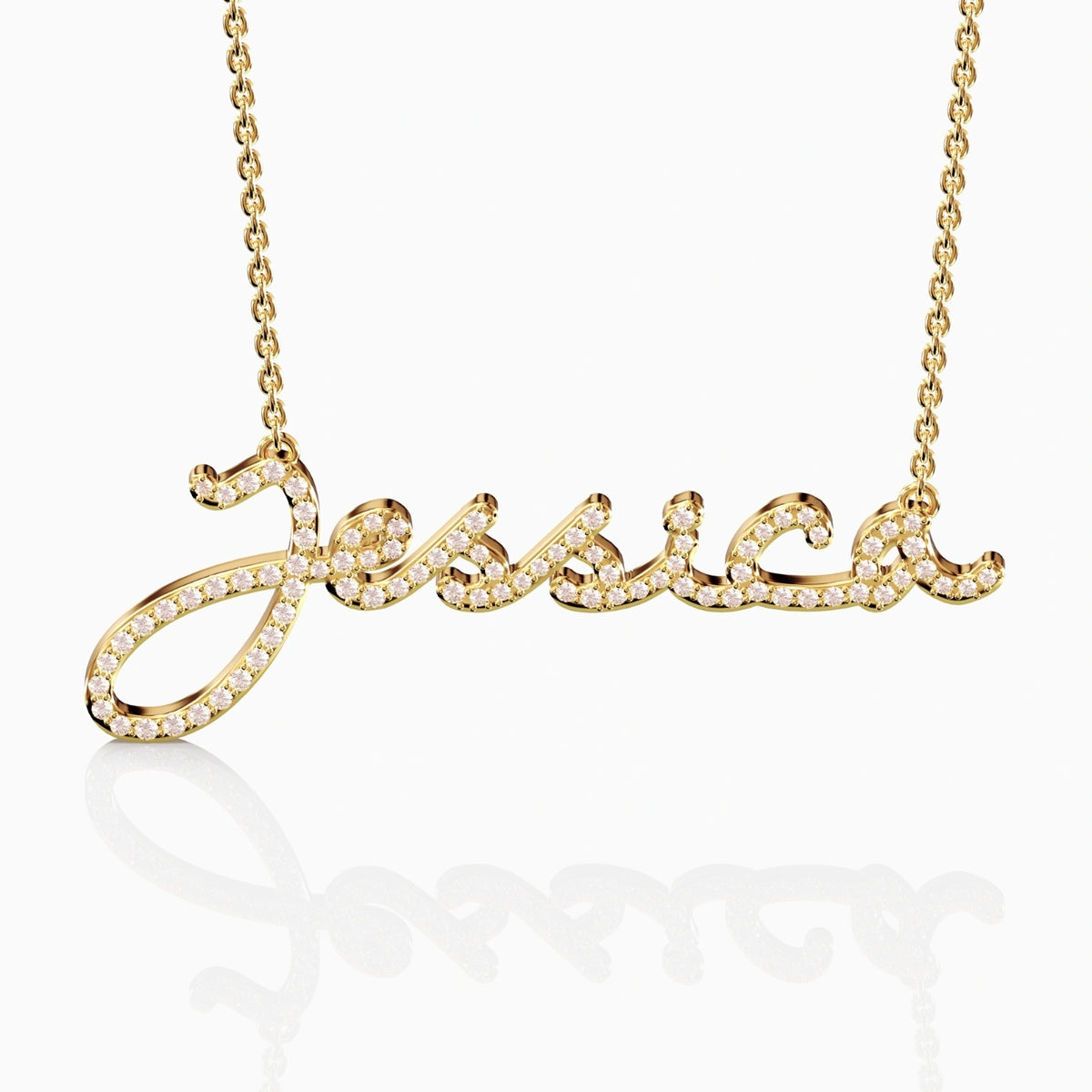

Script Diamond Name Necklace

Written by Katie Silver